
Plan
How big should a garden pond be?
RHS depth and surface-area figures for a UK garden pond, plus shelves, a beach edge and a worked example.
Start with the job the pond has to do. A wildlife pond wants a shallow beach and a varied depth. A fish pond wants enough surface and a deeper pocket so the water is less likely to overheat or freeze solid. The pond planner turns your length, width and depths into litres.
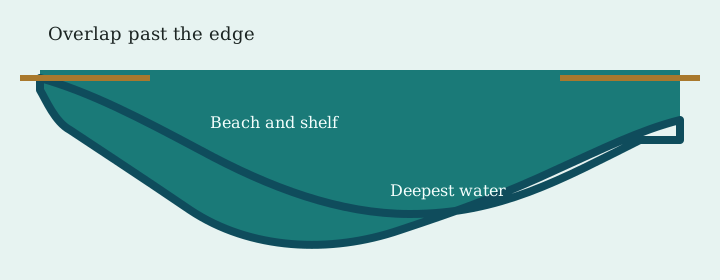
What the RHS actually says about depth
The RHS construction advice is more specific than a shop slogan:
- Every pond should be at least 38 cm (15 in) deep. Shallower water overheats in summer, which feeds algae and can leave fish or other pondlife short of oxygen, and it is more likely to freeze in winter.
- Ideally the water is at least 75 cm (30 in) deep if you want the widest range of plants.
- If the pond has to be small, make at least part of it deep.
- Sides should slope at about 20 degrees, so ice has somewhere to expand.
- A shallow pebble beach, or a ramp, lets wildlife climb out.
- If you want fish, aim for a surface of at least 3.5 square metres (38 square feet) so the water stays better aerated. Heavily stocked fish ponds usually need a filter, and that filter needs space beside the pond.
The RHS wildlife-pond page pulls in a different direction, on purpose. It says a varied depth of about 20–60 cm suits most pond plants and animals, with at least one long shallow slope. A beach at 10–20 cm and a deeper pocket toward the 60–75 cm range is how those two pages fit together. Shelves do not need extra liner: size the liner from the maximum depth. They do reduce the volume, which is why the planner asks for average depth as well as the deepest point.
A worked example
A rectangle 3 m by 2 m has a surface of 6 square metres, which is above the RHS 3.5 square metre mark for fish. If the average depth is 0.6 m, the volume is 3 × 2 × 0.6 × 1,000 = 3,600 litres. PondXpert's own volume example uses one depth for a box: 3 × 2 × 1 × 1,000 = 6,000 litres. Use the average when the pond has shelves, or you will buy a pump and filter for water you do not have.
An oval of the same length, width and average depth is smaller. The planner treats it as an ellipse, π/4 times the rectangle, about 2,827 litres for that 3 m × 2 m × 0.6 m oval.
Fish, wildlife, or both
The RHS is blunt about mixing them. Goldfish are predators in a small pond. They raise nutrients, which feeds algae and blanketweed, and they eat the animals a wildlife pond is for. If you have inherited fish, the wildlife page suggests rehoming them or digging a second pond. Do not add goldfish to a pond you want for frogs and newts.
Koi need more filtration than goldfish, not just a bigger hole. See pump size and filter size. This site cannot tell you how many fish a pond can hold. Stocking is a question for an aquatic specialist, and a sick fish is a question for a vet.
Where this leaves the dig
Mark the outline before you dig, including the beach and the shelf. Check the site against where to put the pond and, if children use the garden, read pond safety before there is any water in it. The RHS says spring and autumn are sensible times to build, because rain is more likely to be available for filling. Use rainwater if you can. Mains water carries nutrients that encourage algae.
How deep does a wildlife pond need to be?
The RHS wildlife guide says a varied 20–60 cm, with a long shallow side. The same organisation's construction page says ponds should be at least 38 cm somewhere, and ideally 75 cm if you want more plant choice. Use both: a beach, and a deeper area.
Do shelves change the volume?
Yes. Water over a shelf is shallower than the deepest point. Measure an average depth for the volume, and the maximum depth for the liner.