
Plan
What size pond liner do I need?
The liner sum used for UK ponds — length and width plus twice the depth plus overlap — and why underlay is not optional.
Affiliate disclosure: if you buy through a link on this page, we may earn a commission. You do not pay more. How this works.
The liner has to cover the bottom, climb both banks, and still have something left to bury or to tuck under edging. Shelves do not add a separate allowance if you measure from the deepest point.
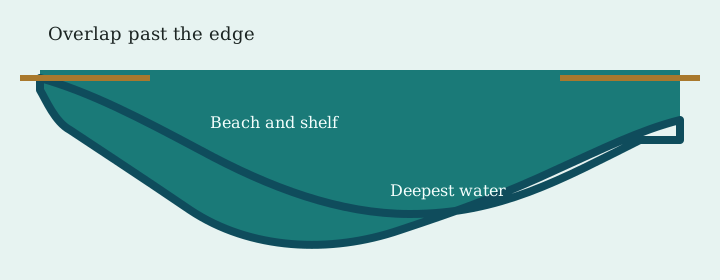
The sum
For each direction:
Liner length = pond length + (2 × maximum depth) + (2 × overlap on one side)
Do the same for the width. This planner uses 0.5 m of overlap on every side, which is the allowance Gordon Low builds into its estimator: it adds 1 m to both length and width, and describes that as 50 cm on each edge. All Pond Solutions describes 30–50 cm past the edge as typical, and tells you to round up to a real sheet. Gordon Low also says the estimator is for planning: measure the finished hole with a flexible tape before you pay for the liner.
A 3 m × 2 m pond, 0.8 m at the deepest point
- Length: 3 + (2 × 0.8) + (2 × 0.5) = 5.6 m
- Width: 2 + (2 × 0.8) + (2 × 0.5) = 4.6 m
Buy a sheet at least that big. A few centimetres short cannot be stretched. Offcuts from a larger sheet are less painful than a seam you did not want.
Some shop listings add only 50 cm in total to each side of the sum, which is 25 cm at each end. That is a thinner margin than Gordon Low's 50 cm each edge. If a product page shows a worked example, read whether the extra is per end or for both ends together. The planner uses 50 cm on every side and says so in the result.
Underlay
All Pond Solutions is clear that underlay protects the liner from stones and roots, and that it is not waterproof and never replaces the liner. Order it for the same area as the liner. If you join pieces, overlap the joins rather than butting them. Sharp gravel under a bare liner is the usual reason a new pond loses water.
A sheet you can actually buy
We haven't tested this. Figures are as the maker states them (checked 13 November 2026).
Pisces Epalyn EPDM, 3.5 m × 6 m. The Amazon UK listing (ASIN B0G8LVZ4FB) describes a 0.75 mm EPDM rubber liner for fish or wildlife ponds, to be laid over underlay. The sheet is 3.5 m by 6 m. On 13 November 2026 the listing price was £262.95. The same listing's own sizing example adds 50 cm once to each dimension after the depth allowance, which is less overlap than the 50 cm per edge used above. Check the current price, thickness and guarantee terms on the page. The listing mentions a lifetime guarantee up to 60 square metres, with terms.
View the Pisces EPDM liner on Amazon UK
That 3.5 × 6 m sheet would cover the 5.6 × 4.6 m example only if you turn it so the 6 m side takes the 5.6 m length. It would not cover a pond whose calculated liner is bigger than 3.5 m in both directions. Measure first.
EPDM, PVC, butyl, preformed
The RHS says butyl is the easy way to make a natural shape, and that preformed plastic or fibreglass ponds usually do not have a shallow slope, so you add a ramp. EPDM is the rubber sheet many UK sellers offer instead of butyl. This page does not claim one brand outlasts another. For a box-shaped preformed shell, see preformed or liner.
Does a planting shelf need more liner?
No. The liner steps down the shelf, but the drop is still the maximum depth, and the shelf is already inside the length and width. All Pond Solutions makes the same point.
Should I buy the exact calculated size?
No. Sheets come in fixed sizes. Round up, then confirm on the dug pond with a tape, which is Gordon Low's advice.